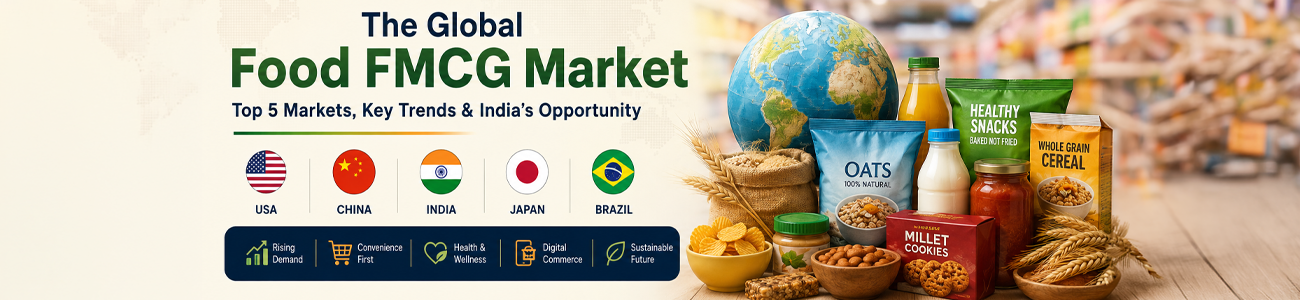
The Global Food FMCG Market: Top 5 Markets, Consumer Trends, and India’s Opportunity
Fast-moving
consumer goods (FMCG) represent the backbone of global retail, yet industry
analyses often blur the lines between personal care, household chemicals, and
packaged nutrition. Among these sectors, Food FMCG stands apart as the most
resilient, operationally demanding, and culturally nuanced segment of consumer
commerce.
Food
products do not behave like cosmetics or laundry detergents. Their consumption
is non-negotiable and daily. Shelf lives are constrained by biological
spoilage, requiring sophisticated cold-chain networks, precise demand
forecasting, and rapid inventory turnover. Furthermore, food purchasing
decisions are deeply personal, tied to local culinary heritage, regional
sensory expectations, dietary traditions, and evolving health perceptions.
Unlike a bottle of shampoo that may sit in a household for months, packaged
food items move through supply chains and pantry shelves at high speed,
operating on razor-thin operating margins and under strict regulatory scrutiny.
Understanding
the global Food FMCG landscape requires a focused examination of how packaged
foods and beverages are formulated, manufactured, branded, and distributed across
the world’s most influential consumer markets.
Defining Food FMCG: Scope and Core Categories
Food FMCG
encompasses fast-moving packaged food and beverage products manufactured for
rapid turnover, direct consumer consumption, and kitchen convenience. It excludes
unpackaged, raw agricultural commodities sold in bulk, as well as non-food
consumer packaged goods.
The core
categories comprising this sector include:
- Dairy and Dairy
Alternatives:
Packaged fluid milk, butter, yogurt, ghee, paneer, artisanal cheeses, and
plant-based milk alternatives such as oat, almond, and soy.
- Packaged Staples: Branded edible oils,
packaged wheat flour (atta), basmati and regional rice, pulses, and
refined sugar.
- Biscuits, Bakery, and
Confectionery:
Sweet biscuits, crackers, packaged breads, cakes, pastries, chocolates,
and traditional sweets.
- Snacks and Savouries: Extruded snacks, potato
crisps, roasted nuts, seeds, and packaged traditional savouries.
- Packaged Beverages: Ready-to-drink (RTD) teas
and coffees, packaged fruit juices, carbonated soft drinks, functional
hydration, and bottled water.
- Convenience Foods: Ready-to-eat (RTE) meals,
ready-to-cook (RTC) gravies and batters, instant noodles, pasta, and
breakfast cereals.
- Sauces, Condiments, and
Culinary Aids:
Cooking pastes, table sauces, mayonnaise, salad dressings, packaged spice
blends, and specialty pickles.
- Healthy, Organic, and
Functional Foods: High-protein snacks, organic packaged
staples, fortified cereals, and clean-label functional nutrition.
Global Market Landscape: Understanding the Numbers
The
global packaged food market was estimated at approximately US$4.85 trillion
in 2025 by Fortune Business Insights and is projected to expand toward US$7.72
trillion by 2034, compounding at an annual growth rate of 5.35%.
The
Asia-Pacific region stands as the primary regional growth engine, accounting
for more than 32% of total global market value representing roughly US$1.59
trillion in 2025. This expansion is propelled by rapid urban migration,
expanding middle-class households, and rising disposable incomes across
developing Asian economies.
Navigating Industry Metrics and Methodological
Differences
When
analysing market sizes, market researchers and consulting firms deploy
differing parameters:
- Packaged Food Retail Market: Measures final consumer
sales of branded, packaged food items across retail channels.
- Food Processing Industry
Revenue:
Tracks the total factory-gate turnover and industrial output of food
manufacturing plants, including intermediate goods, food ingredients, and
export shipments.
- Food and Grocery Retail
Market:
Encompasses the entire grocery ecosystem, including unpackaged fresh
produce, loose grains, and wet-market commodities.
- Food and Beverage Market: Combines packaged consumer
goods with food service, commercial hospitality, and institutional
catering revenues.
Comparing
national markets requires acknowledging these definitions rather than
presenting disparate datasets as identical metrics.
The World’s Top 5 Food FMCG Markets
The top
five markets illustrate how economic development, demographics, and distribution
infrastructures shape consumer spending and retail formats.
1. United States: The Global Anchor of Value and
Premiumisation
Valued at
approximately US$1.42 trillion in 2025 for packaged food, the United
States is the world's most mature and structurally developed Food FMCG market.
Caloric availability across the population is saturated; therefore, growth is
driven not by volume expansion, but by aggressive value creation.
American
consumers prioritize convenience, clean formulations, and functional health
benefits. The market has seen a marked transition away from heavily processed
centre-aisle legacy brands toward perimeter shopping, functional snacking, and
transparently sourced specialty foods. Key growth segments include high-protein
products, gut-health and probiotic-infused beverages, keto- and paleo-aligned
packaged goods, and single-serve on-the-go meal kits. Because physical product
availability is universal, brand differentiation relies heavily on ingredient
transparency, ethical sourcing certifications, and distinct sensory branding.
2. China: Scale, Value Recalibration, and Digital
Dominance
China’s
packaged food market stands at approximately US$520 billion in 2025.
According to the Bain & Company and Worldpanel China Shopper Report,
packaged food demonstrated notable resilience, recording approximately 3.4%
value growth in the first three quarters of 2025, consistently
outperforming non-food FMCG segments.
The
Chinese consumer mindset has shifted from uninhibited trading-up to a deliberate
search for value demanding high nutritional quality, verified food safety, and
aesthetic appeal at rational price points. Hyper-convenience, instant noodles,
premium ready meals, healthy snacking, and functional dairy continue to record
robust domestic demand. Concurrently, retail distribution has evolved: digital
channels, social commerce, and livestream selling platforms now sit at the
centre of food discovery and volume sales, particularly in lower-tier cities
where modern offline retail infrastructure remains fragmented.
3. India: High-Velocity Volume Growth and Channel
Disruption
India
represents one of the world's fastest-growing Food FMCG frontiers, with its
packaged food sector reaching approximately US$240 billion in 2025.
India’s expansion is anchored by fundamental structural tailwinds: a young
median population, rapid urbanization, rising disposable household income, and
the formalization of unbranded, loose agricultural staples into sealed, branded
alternatives.
What
distinguishes India is its rapid channel evolution. India has largely bypassed
traditional supermarket expansion in favour of hyperlocal quick commerce.
According to a Bain & Company and Flipkart report cited by Reuters, India’s
quick-commerce market reached US$6–7 billion in 2024, accounting for
over two-thirds of the country’s online grocery orders. Dark stores delivering
within 10 to 15 minutes have revolutionized snacking, dairy, and culinary
staple consumption, providing immediate retail access for emerging and regional
food brands.
4. Japan: Precision, Portion Control, and
Functional Aging
Valued at
roughly US$190 billion in 2025, Japan’s packaged food market provides a
case study in how a mature market with an aging demographic can sustain
economic value through specialization and technical innovation.
Japanese
Food FMCG is characterized by rigorous quality control, sophisticated packaging
engineering, and single-serve portion sizes tailored to single-person
households and senior citizens. Functional foods targeting longevity,
cardiovascular health, cognitive function, and digestive wellness are deeply
integrated into daily shopping habits. Furthermore, Japan’s convenience store
network (konbini) serves as a daily distribution ecosystem for fresh,
high-quality ready-to-eat meals, showcasing how supply chain precision can
deliver fresh packaged food at scale.
5. Brazil: Agricultural Integration and Processing
Power
According
to data from the Brazilian Food Processors’ Association (ABIA) published by the
USDA Foreign Agricultural Service, Brazil’s food processing industry recorded
revenues of approximately US$233 billion in 2024. This figure represents
industrial processing turnover rather than direct packaged retail sales,
highlighting Brazil's distinct dual role as an intensive domestic consumer
market and an agricultural supplier to global supply chains.
Within
the domestic packaged food market, core demand centres on dairy products,
biscuits, pasta, edible oils, processed meats, confectionery, and packaged
staple foods such as rice and beans. As urban working populations grow, demand
for shelf-stable convenience foods, portion-controlled snacks, and fortified
everyday nutrition is accelerating across major metropolitan centres.
Six Macro Trends Reshaping the Global Food FMCG
Sector
Across
developed and emerging economies, six overarching consumer and structural
shifts are reshaping product formulation, packaging design, and retail
distribution.
1. The Global Wave of Premiumisation
Across
both advanced and developing economies, consumers are increasingly willing to
pay a premium for higher quality. This shift does not mean purchasing luxury
delicacies; rather, it reflects a willingness to pay more for everyday items
that offer clean ingredients, verifiable provenance, artisanal preparation, and
superior sensory profiles. In categories ranging from packaged tea and coffee
to potato chips and table sauces, entry-level commodity products face margin
compression, while premium, differentiated variants capture market share.
2. The Health, Wellness, and Functional Nutrition
Mandate
Nutrition
is no longer viewed solely through the lens of caloric intake; consumers
increasingly view food as preventive medicine. Key trends include:
- Clean-Label Formulations: Elimination of artificial colours,
synthetic flavours, chemical preservatives, and unpronounceable additives.
- Macro-Nutrient Density: Widespread demand for
high-protein, high-fibre, low-sugar, and low-sodium reformulations.
- Active Functionality: Fortification with
probiotics for gut health, adaptogens for stress management, and botanical
extracts for immunity.
- Minimal Processing: A structural pivot away
from ultra-processed formulations toward cold-pressed, gently baked, or
dehydrated real-food ingredients.
3. Hyper-Convenience and Time-Compressed Lifestyles
Urbanization,
long commutes, and the rise of dual-income households have constrained meal
preparation time. Consequently, convenience is no longer a luxury but an
operational necessity. Consumers demand food solutions that eliminate culinary
friction without compromising nutritional quality or taste. This shift has
driven growth across ready-to-cook (RTC) spice pastes, pre-marinated proteins,
5-minute meal kits, and shelf-stable retort-packaged dishes that require only
heating.
4. Digital Commerce, Quick Commerce, and
Omnichannel Discovery
The
traditional linear path to purchase discovering a product via television
advertising and buying it at a physical supermarket has fragmented. Digital
channels are now primary discovery engines:
- Social and Livestream
Commerce:
Video-first social platforms drive food discovery and direct-to-consumer
impulse buying.
- Quick-Commerce Velocity: 10-to-20-minute dark-store
deliveries have transformed spontaneous snacking and staple replenishment,
compressing product purchase cycles.
- Digital-First Brands: Emerging food startups can
bypass physical retail slotting fees to validate product-market fit
digitally before expanding into physical distribution.
5. Packaging as a Strategic and Operational Tool
Modern
Food FMCG packaging must perform multiple complex functions simultaneously:
- Product Protection and
Shelf-Life Extension: Utilizing advanced multi-layer barrier films
and modified atmosphere packaging (MAP) to prevent oxidation and moisture
ingress without relying on synthetic preservatives.
- Digital and Physical Shelf
Visibility:
Designing vibrant visual assets optimized for mobile app product
thumbnails as well as crowded physical store aisles.
- E-Commerce and Logistics
Durability:
Engineering flexible, rupture-resistant pouches capable of withstanding
rough handling in parcel delivery and rapid two-wheeler last-mile transit.
- Portion Control and
Resealability:
Offering single-serve formats for on-the-go consumption, alongside
zip-lock standing pouches that preserve freshness over multiple uses.
- Environmental
Sustainability:
Transitioning toward mono-material recyclable laminates, reduced plastic
weights, and biodegradable substrates in response to consumer demand and
tightening packaging waste regulations.
6. Modernization and Industrialization of Cultural
Foods
Global
consumers are increasingly eager to explore authentic international cuisines,
while domestic consumers in emerging markets are rediscovering their own
regional heritage. Traditional, labour-intensive culinary recipes are being
standardized, hygienically manufactured, and packaged into modern, shelf-stable
formats, transforming localized family recipes into scalable commercial brands.
Strategic Playbooks: What Global Markets Teach Us
Food FMCG
enterprises can extract valuable strategic insights from the world's leading
consumer markets:
- From the United States: Master the art of category
premiumisation and rapid functional innovation. US brands excel at turning
emerging wellness concepts into scaled, mainstream retail categories with
compelling lifestyle branding.
- From China: Learn supply chain speed,
channel agility, and price-to-value balancing. Chinese companies
demonstrate how to deploy agile manufacturing and responsive digital
marketing to serve diverse consumer tiers without sacrificing margins.
- From Japan: Emulate packaging
ergonomics, quality control, and micro-segmentation. Japanese brands
highlight how rigorous hygiene, premium visual presentation, and
single-serve portioning can drive profitability even within a mature,
low-volume-growth environment.
- From Brazil: Leverage agricultural
integration and processing scale. Brazil illustrates the strategic
advantage of securing domestic raw-material supply chains to maintain
competitive cost structures during global commodity volatility.
India: The Epicentre of Future Food FMCG Growth
India
stands at a pivotal intersection of demographic advantage, agricultural
abundance, and digital infrastructure, positioning the country as one of the
most compelling Food FMCG growth markets of the next several decades.
Several
fundamental drivers underpin this opportunity:
- Unrivaled Scale and
Favourable Demographics: With a population exceeding 1.4 billion
people, a median age below 30, and expanding urban centres, India offers
an expanding consumer base with decades of active consumption ahead.
- Expanding Incomes and Rural
Demand:
Rising household incomes across Tier-2 and Tier-3 cities, paired with
growing electrification and digital connectivity in rural markets, are
expanding the addressable consumer base for packaged consumer goods.
- World-Class Agricultural
Foundation:
India ranks among the global leaders in the production of milk, spices,
pulses, rice, wheat, sugarcane, fruits, and vegetables, providing food
processors with immediate access to raw inputs.
- The Formalization
Imperative: A
substantial portion of India's daily food consumption remains unbranded
and locally sourced. As consumer awareness of food hygiene, adulteration
risks, and standardized quality increases, millions of households are
shifting from loose commodities to trusted packaged brands.
- Digital and Quick-Commerce
Infrastructure:
India's rapid deployment of digital payment rails and dense quick-commerce
networks allows new food brands to achieve nationwide visibility and
immediate distribution far faster than traditional retail models permitted.
The Scale Opportunity for Regional and Heritage
Brands
India's
most significant competitive advantage lies in transforming its vast culinary
diversity into modern, branded, and export-ready packaged food products.
Key
regional categories primed for industrial scale and brand building include:
- Traditional Regional Snacks: Scaling authentic regional
specialties such as Kerala's cold-pressed coconut oil banana chips,
Western India's roasted farsan, and South India's traditional savouries into
vacuum-packed, nitrogen-flushed, clean-label snacks for domestic and
international markets.
- Millet-Based and Ancient
Grain Foods:
Utilizing climate-resilient, nutrient-rich millets (ragi, jowar, bajra) to
produce modern breakfast cereals, gluten-free pastas, baked snack crisps,
and functional energy bars.
- Single-Origin and Processed
Spices:
Upgrading bulk commodity spices into traceable, cold-ground, single-origin
packaged spice blends, specialty dry rubs, and regional seasoning mixes.
- Ready-to-Cook Regional
Pastes and Gravies: Manufacturing authentic, preservative-free
curry bases, biryani pastes, and fermented idli/dosa batters that
eliminate multi-hour preparation times for busy urban professionals.
- Artisanal Pickles, Chutneys,
and Condiments:
Reimagining traditional oil- and brine-cured pickles and wet chutneys
through modern food processing and MAP packaging to preserve natural
flavours without excessive sodium or chemical preservatives.
- Value-Added Dairy and
Traditional Beverages: Modernizing shelf-stable ethnic beverages such
as spiced buttermilk (chaas), badam milk, and regional herbal infusions alongside
packaged dairy products like artisanal ghee, paneer, and functional
yogurts.
By
combining modern food processing technology, modified atmosphere packaging,
automated production lines, and clear brand storytelling, regional
manufacturers can evolve beyond localized operations into national market
leaders and global export brands serving the international diaspora and
mainstream international consumers.
Strategic Imperatives for Modern Food FMCG Brands
Winning
in the modern Food FMCG landscape requires a clear and coordinated commercial
playbook:
- Formulate for Health Without
Sacrificing Taste: Health and wellness attributes attract
initial consumer interest, but flavour profile and sensory texture drive
long-term repeat purchases.
- Design Packaging for Modern
Multi-Channel Retail: Packaging must maintain physical barrier
integrity during last-mile transit while standing out visually on digital
quick-commerce apps and crowded physical retail shelves.
- Balance Scale with Product
Authenticity: As
production scales, brands must maintain recipe integrity, consistent
ingredient sourcing, and distinctive flavour profiles to retain consumer
trust.
- Build Agile Omnichannel
Distribution:
Companies should use quick commerce and digital channels for rapid
consumer trial and market validation, while systematically building
physical retail distribution to capture long-term volume.
Conclusion
The
global Food FMCG industry has entered a new phase characterized by value-led
growth, functional nutrition, and digital channel integration. While the United
States, China, Japan, and Brazil offer mature blueprints in premiumisation,
value management, operational precision, and supply chain scale, India
represents the most dynamic consumption frontier in the global market.
For food
entrepreneurs, established manufacturers, and brand strategists, the path
forward is straightforward: develop products that honour authentic flavour profiles,
ensure consistent ingredient transparency, engineer packaging for the modern
digital and physical shelf, and build agile distribution networks to serve
today's health-conscious, convenience-driven consumer.
Sources & References
- Fortune Business Insights Packaged
Food Market Size, Share & Industry Analysis, 2026–2034 (2026)
https://www.fortunebusinessinsights.com/packaged-food-market-106049
- Bain & Company &
Worldpanel China
Shopper Report 2025, Vol. 2: Adapting to Channel Evolution (2025)
https://www.bain.com/insights/china-shopper-report-2025-volume-2/
- USDA Foreign Agricultural
Service Brazil:
Food Processing Ingredients Annual Report (2024)
https://www.fas.usda.gov/data/brazil-food-processing-ingredients-annual
- Reuters / Bain & Company
& Flipkart India
Quick Commerce Market & E-Grocery Disruption Report (2024–2025)
- India Brand Equity
Foundation (IBEF) Indian Food Processing Industry &
FMCG Sector Analysis (2025)
https://www.ibef.org/industry/food-processing-india