AI vs Human Designers: What Actually Happens When AI Enters Packaging Design?
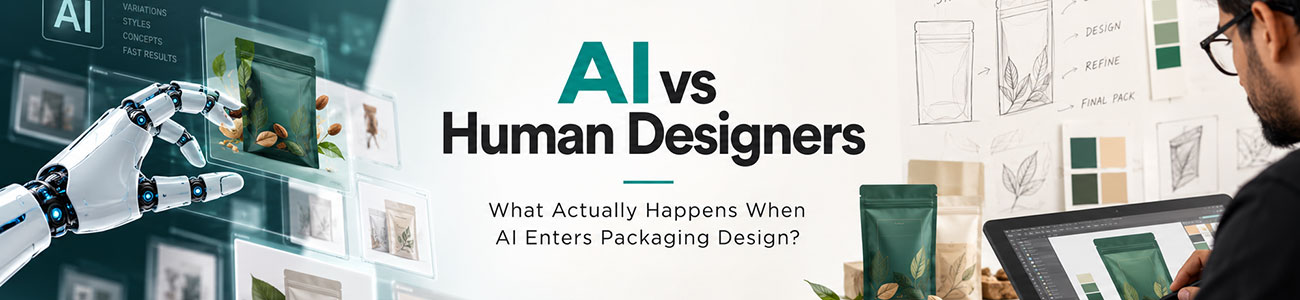
Artificial
intelligence has moved from being a futuristic idea to a practical creative
tool. Today, AI can generate images, explore visual styles, suggest concepts
and produce creative variations in seconds. Naturally, this has raised an
important question for brands: Can AI design packaging?
The short
answer is yes. But there is a much bigger question behind it: Can AI design
packaging that actually works for a real brand, real consumer and real market?
For FMCG
companies, food manufacturers, D2C brands and startups, packaging is more than
an attractive visual. It has to communicate the product quickly, stand out
among competitors, support the brand strategy, work within printing and
manufacturing limitations, and remain consistent as the product range grows.
This is where
the conversation around AI vs human designers becomes more interesting.
AI can dramatically improve the creative process, but professional packaging
design still requires human judgement.
What Does
AI Packaging Design Actually Mean?
AI packaging
design refers to using artificial intelligence tools during different stages of
the packaging creation process.
Modern AI
packaging design tools can generate visual concepts, illustrations, patterns,
backgrounds, color directions, product scenes and creative references from
written prompts. Designers can use these outputs to explore ideas that might
otherwise take hours to visualize manually.
For example,
imagine a new premium date brand entering the Indian market. A designer might
use AI to explore several possible visual territories: a luxury Middle
Eastern-inspired direction, a contemporary minimal approach, a natural wellness
aesthetic or a bold FMCG shelf-focused concept.
The
AI-generated images are not necessarily the final packaging. They are
possibilities.
This
distinction is important.
AI
generated packaging design can show what an idea might look like, but it does
not automatically determine whether that idea is right for the brand.
That decision
still requires strategy and experience.
What
Happens When AI Enters a Real Packaging Design Project?
In a real
packaging project, the process usually starts long before anyone creates a
visual.
A packaging
design company first needs to understand the product, target customer, market
position, competitors, pricing, distribution channels and brand personality.
Consider a
new Kerala-based snack brand launching banana chips across supermarkets and
online marketplaces. The design needs to communicate what the product is,
create appetite appeal, establish a recognizable identity and differentiate the
pack from dozens of competing snack products.
AI can help
generate visual directions quickly. But someone still needs to decide which
direction makes commercial sense.
A designer
might ask:
Does the
design look premium or inexpensive?
Can the
product name be read from a supermarket shelf?
Does the
color differentiate the brand from competitors?
Will the
identity work across multiple flavors?
Can the
illustration be reproduced effectively in print?
Does the
packaging communicate the product in a few seconds?
These are not
simply image-generation problems. They are design and business decisions.
The
Benefits of AI in Packaging Design
Used
properly, AI in packaging design can make the creative process considerably
faster.
Faster
Ideation
One of the
biggest advantages of AI is speed.
Instead of
developing one visual direction and then spending significant time creating
variations, designers can explore numerous possibilities rapidly. Different
compositions, illustration styles, photography approaches and environments can
be tested before committing to a particular creative route.
This is
particularly useful during the early concept stage.
More
Creative Exploration
Sometimes a
designer has an idea that is difficult to communicate through words alone. AI
can help visualize that idea quickly.
For example,
a food packaging designer might want to explore a tropical ingredient story, a
traditional Kerala visual language or a contemporary editorial photography
style. AI can create references that help the design team understand which
direction has potential.
The purpose
is not necessarily to use the generated image directly. It is to accelerate
thinking.
Faster
Mood boards and References
AI can also
support mood board development.
A designer
working on premium coffee packaging might explore different combinations of
typography, photography, textures, colors and illustration styles before
establishing a visual language.
This makes
conversations with clients more concrete. Instead of discussing an abstract
idea, the team can compare visual territories.
Rapid
Visual Experimentation
Packaging
design often involves experimentation.
What happens
if the background becomes darker? What if the product illustration becomes
larger? What if the package uses a more minimal composition?
AI makes this
kind of experimentation easier.
For design
teams working on multiple FMCG products or large SKU ranges, this can save
considerable creative time.
Support
for Product Visualization
AI can also
help create presentation environments and conceptual mockups.
A new
beverage package, for example, can be visualized in a retail environment,
outdoor setting or lifestyle scene before final product photography is
available.
Again, these
visuals are useful for communication and exploration rather than automatically
replacing final production artwork or photography.
The
Limitations of AI-Generated Packaging
The biggest
mistake brands can make is assuming that a visually impressive AI image
automatically represents good packaging design.
It does not.
AI does not
inherently understand the complete business strategy behind a product.
A generated
design may look beautiful but fail to communicate the product clearly. It may
create an attractive composition that does not work at small sizes. It may
produce typography that is unusable, inconsistent visual elements, inaccurate
product details or artwork that cannot be translated properly into a
production-ready file.
There are
also practical considerations around printing, materials, dielines, color
reproduction, finishing techniques, mandatory information and packaging
regulations.
For food
products in particular, packaging must accommodate important information such
as ingredients, nutritional information, declarations and other required
details.
An AI image
generator is not a substitute for technical packaging knowledge.
Why
Attractive Packaging Is Not Always Effective Packaging
Imagine two
products sitting next to each other on a supermarket shelf.
One package
is visually sophisticated. It has beautiful imagery, interesting colors and an
impressive illustration.
The second
package is slightly less artistic but immediately communicates the brand,
product category, key benefit and flavor.
The second
package may have a better chance of performing commercially.
Packaging
exists in a competitive environment. Consumers rarely examine a package in
isolation. They see it beside competing brands, often for only a few seconds.
This is why FMCG
packaging design requires a combination of creativity and strategic
thinking.
A good
package has to answer several questions quickly:
What is this
product?
Who makes it?
Why should I
notice it?
What makes it
different?
Why should I
choose it?
AI can help
generate visual possibilities. A professional packaging designer decides how
those possibilities should answer these questions.
AI Is a
Creative Assistant. The Designer Is the Decision Maker.
This is
perhaps the most useful way to understand the relationship between AI and
graphic design.
AI is
extremely good at generating possibilities.
Human
designers are responsible for making decisions.
A
professional packaging designer brings knowledge of brand positioning, consumer
psychology, visual hierarchy, typography, color strategy and competitive
differentiation.
They also
understand the practical side of packaging.
The designer
needs to consider the printing process, substrate, finishing, production
limitations, artwork preparation and consistency across a complete product
range.
For a food
manufacturer launching five flavors, the challenge is not simply creating five
attractive packs. The designs need to belong to the same brand family while
making each SKU easy to identify.
That is where
packaging branding becomes important.
What Does
a Professional Packaging Designer Actually Do?
A
professional packaging designer works between business strategy and visual
communication.
They may
begin by analyzing competitors and identifying opportunities in the category.
They study how brands use color, typography, photography, illustrations and
product claims.
Then they
establish a creative direction.
The designer
decides what should dominate the front panel, how the brand name should behave,
how the product name should be presented and how supporting information should
be organized.
They also
think about the future.
If today's
product is a single pack of cookies, will the same identity work when the brand
introduces chocolate cookies, millet cookies, gift boxes and family packs?
This kind of
thinking creates a scalable packaging system rather than a one-off design.
How AI and
Human Designers Can Work Together
The strongest
approach is not AI versus humans. It is AI-assisted human creativity.
A practical
packaging workflow could look like this:
Brand
research: Understand
the product, company, audience and objectives.
Market and
competitor analysis:
Study the category and identify visual opportunities.
Creative
strategy: Establish
positioning, personality and visual direction.
AI-assisted
ideation: Generate
references, concepts, illustrations and visual possibilities.
Human
concept selection:
Evaluate which ideas actually fit the brand and market.
Packaging
development: Build
the identity, typography, color system, imagery and hierarchy.
Technical
adaptation: Apply the
design to actual dielines, sizes, materials and production requirements.
Mockups
and presentation:
Demonstrate how the packaging will appear in realistic environments.
Client
feedback: Refine the
selected direction based on practical and strategic feedback.
Final
artwork: Prepare
production-ready packaging files.
In this
workflow, AI increases creative speed without removing human responsibility.
Can AI
Replace Packaging Designers?
Not
completely.
AI may reduce
the amount of time designers spend on certain repetitive or exploratory tasks.
It may also change the skills that packaging designers need.
Designers who
understand AI tools can potentially explore more ideas, communicate concepts
faster and work more efficiently.
But replacing
a packaging designer requires replacing much more than the ability to create an
image.
It would
require understanding brand strategy, consumer behavior, packaging
architecture, typography, production, regulatory requirements, commercial
positioning and long-term brand consistency.
Those
decisions remain highly contextual.
The future
packaging designer may therefore spend less time manually producing every
visual element and more time directing, evaluating and refining creative work.
The Future
of Packaging Design
The future of
packaging design will likely involve AI as part of the everyday creative
workflow.
This could be
particularly valuable for FMCG and D2C brands where speed matters.
Brands are
launching more products, testing more variations and creating content for both
physical retail and digital commerce. Packaging must work not only on shelves
but also in online product listings, advertisements and social media.
AI can help
creative teams respond faster to these demands.
For example,
a brand launching a new beverage might need multiple visual concepts, campaign
environments and digital product scenes. AI can accelerate the exploration of
these assets while the core packaging identity remains controlled by the design
team.
This makes AI
a valuable addition to the designer's toolkit rather than a replacement for
design thinking.
Should
Your Brand Use AI for Packaging Design?
Yes, but with
the right expectations.
Brands can
use AI for brainstorming, visual exploration, mood boards, creative references
and early-stage concept development.
However, the
final packaging should be evaluated by people who understand branding,
packaging production and the commercial environment in which the product will
compete.
This is
especially important for food packaging design and FMCG products, where
clarity, compliance, manufacturability and shelf impact all matter.
If your goal
is simply to create an attractive concept image, AI may be enough.
If your goal
is to build a packaging system that represents a real brand and works in the
marketplace, professional design expertise remains essential.
Where
Rainbowgraph Fits In
At
Rainbowgraph, packaging is approached as a combination of brand strategy,
creativity and practical design thinking.
As a
packaging design and branding agency in India, the focus is not simply on
producing attractive artwork. The objective is to understand the product,
consumer, category and brand story before developing the visual language.
Modern
technology, including AI, can make parts of the creative process faster. But
technology is only useful when it supports better decisions.
A successful
packaging project still needs people who can identify the right opportunity,
build a meaningful visual identity and translate that identity into packaging
that works across real products and real markets.
Conclusion:
AI Can Generate Possibilities. Designers Create Decisions.
The most
useful way to think about AI packaging design is not as a competition
between machines and designers.
AI can
generate possibilities at remarkable speed. It can help designers explore
visual directions, experiment with ideas and move through the early creative
stages faster.
But packaging
is ultimately about decisions.
Which idea
represents the brand?
Which color
will help the product stand out?
Which
information needs to be seen first?
How should
the identity work across different SKUs?
Will the
design survive real-world printing and production?
Will
consumers understand it quickly?
These
decisions turn an image into packaging.
The future of
packaging design is therefore unlikely to be simply AI or human creativity. It
will be the combination of both.
AI can
generate possibilities. Designers create decisions. And the strongest packaging
happens when technology supports human creative thinking rather than trying to
replace it.